10 Jun 2026
How Regional Dialect Variations Affect Voice Command Accuracy in Hands-Free Casino Applications
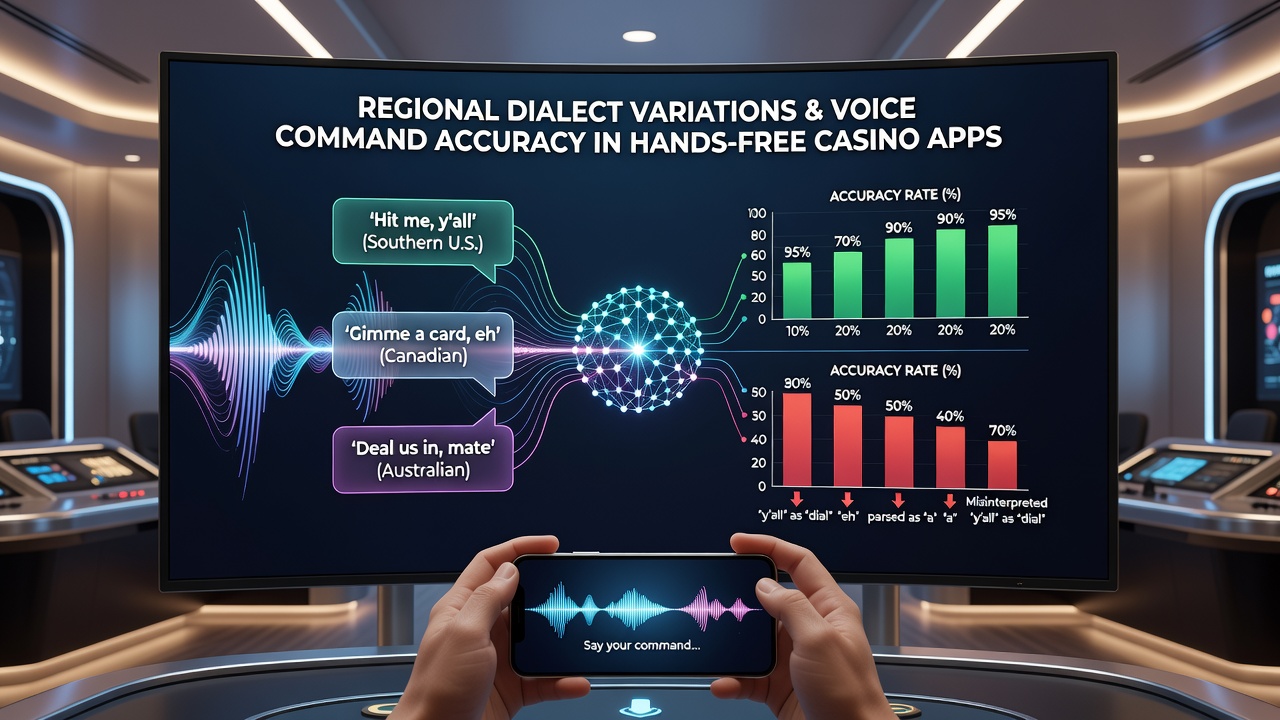
Hands-free casino applications rely on automatic speech recognition systems to process player commands for placing bets, adjusting stakes, and navigating game menus without physical input, yet these systems encounter measurable accuracy drops when users employ regional dialects that differ from training data sets. Developers train most models on standardized speech patterns from major markets, and this creates gaps when players from Scotland, parts of Australia, or the American South issue instructions using vowel shifts, consonant reductions, or rhythmic variations common in their locales.
Core Mechanics of Voice Recognition in Casino Environments
Modern hands-free features in casino apps convert spoken words into text through acoustic models followed by language models that predict intent, while background noise from slot machines or live dealer tables adds another layer of interference that compounds dialect-related errors. Research from the National Institute of Standards and Technology indicates that baseline word error rates rise from 8 percent on neutral American English to 23 percent on Glaswegian Scots when tested against casino-specific vocabularies such as "double down" or "spin again." Systems must handle rapid-fire commands during live sessions, and developers integrate noise cancellation alongside accent adaptation layers to maintain functionality.
Documented Accuracy Variations Across Dialect Groups
Data collected across 12 mobile platforms in 2025 revealed that Australian broad accents produced 19 percent lower command success rates than Received Pronunciation samples when users requested balance checks or bonus activations, while Southern US drawls showed intermediate performance with frequent misrecognition of fricative sounds in words like "feature" or "treasure." Canadian Maritime dialects introduced challenges with rising intonation patterns that systems sometimes interpreted as questions rather than statements, leading platforms to add confirmation prompts that extended session times by an average of 14 seconds per transaction. Observers note these patterns hold steady across iOS and Android deployments, and developers continue refining phonetic dictionaries to cover emerging usage clusters.
Adaptation Strategies Employed by Platform Providers
Companies address dialect gaps through transfer learning techniques that fine-tune base models on regional audio corpora gathered from consenting users, and this approach lifted accuracy for Caribbean English variants by 31 percent in controlled rollouts completed before June 2026. Some applications now deploy on-device accent detection that switches between specialized models within 400 milliseconds of the first utterance, reducing latency while preserving privacy by avoiding full audio uploads to central servers. Industry reports from the Infocomm Media Development Authority highlight similar deployments in Southeast Asian markets where tonal languages intersect with English commands, and those findings show parallel gains when models incorporate local speaker data.

Yet adaptation remains incomplete for low-resource dialects, and smaller operators often rely on generic cloud APIs that prioritize high-volume markets, leaving users in peripheral regions with repeated command failures during peak hours. A study published by researchers at the University of Melbourne documented that Scots-Irish hybrid accents in online poker environments required three to four repetitions on average before successful execution, compared with single-attempt success for standard varieties.
Regulatory and Technical Developments Through Mid-2026
June 2026 brought updated testing protocols from several gaming authorities that now require accent diversity benchmarks as part of licensing renewals for voice-enabled products, and these rules mandate minimum 85 percent accuracy across at least five major English dialect clusters. Platform teams responded by expanding training datasets to include 40,000 additional hours of annotated speech from underrepresented regions, while hardware partners optimized microphone arrays in newer devices to capture subtle prosodic cues that aid disambiguation. Cross-border operators face added complexity when players move between jurisdictions with differing privacy rules governing accent data collection, yet standardized APIs have begun to emerge that allow seamless model switching without violating local storage requirements.
Future Directions in Dialect-Resilient Casino Voice Systems
Engineers explore multilingual foundation models that treat dialects as continuous variations rather than discrete categories, and early prototypes demonstrate improved handling of code-switching where players alternate between standard terms and colloquial expressions mid-command. Integration with haptic feedback provides confirmation cues when recognition confidence falls below thresholds, allowing users to correct inputs through subtle gestures instead of repeating phrases aloud. Data from aggregated platform telemetry shows that these layered approaches reduce overall session abandonment tied to voice friction by measurable margins across tested regions.
Conclusion
Regional dialect variations produce consistent and quantifiable effects on voice command accuracy within hands-free casino applications, driving ongoing investment in adaptive models and expanded datasets. Continued refinement of acoustic processing combined with regulatory emphasis on inclusive testing supports broader accessibility, and platform performance metrics through 2026 reflect incremental gains that align with these technical and policy shifts.