21 Jun 2026
Exploring Synchronization Challenges in Cloud-Based Multiplayer Slot Sessions Across Varying Network Conditions

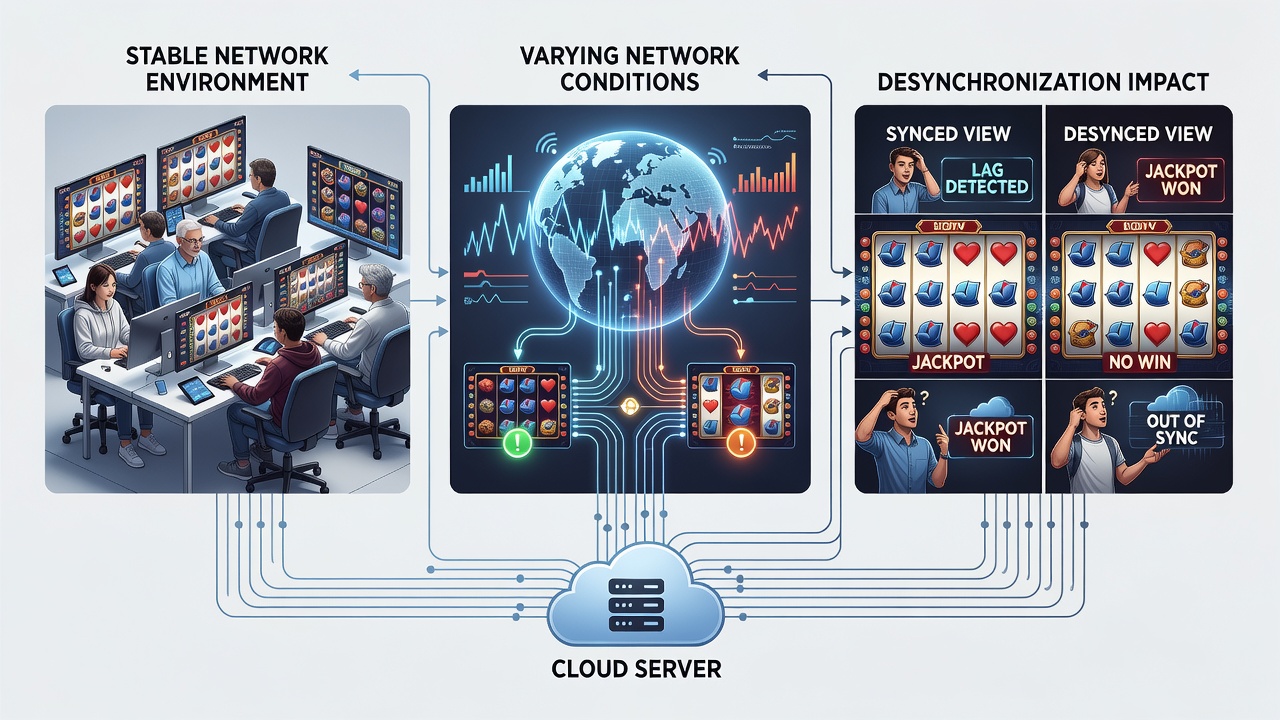
Cloud-based multiplayer slot sessions rely on centralized servers to coordinate real-time actions among participants distributed across global networks, yet synchronization issues emerge when latency spikes or packet delivery falters under inconsistent conditions. Researchers have documented how these environments process simultaneous reel spins, bonus triggers, and jackpot contributions while contending with fluctuations that range from stable fiber connections to congested mobile data streams.
Core Mechanics of Multiplayer Slot Synchronization
Operators deploy cloud infrastructure to manage shared game states where each participant's input must align within milliseconds to prevent discrepancies in displayed outcomes or shared prize pools, and data from industry reports shows that typical systems use WebSocket protocols combined with server reconciliation loops to broadcast updates. When players join a session the server establishes a baseline state that includes current reel positions and accumulated contributions, then it propagates changes to all connected clients while applying predictive algorithms that anticipate minor delays.
Studies conducted through 2025 and into June 2026 reveal that synchronization windows often shrink below 50 milliseconds in high-stakes rooms, forcing platforms to implement rollback mechanisms that correct desynchronized states without interrupting the overall flow. Those who've analyzed server logs note that even brief jitter can cause one player to see a bonus round initiate before another receives the matching update.
Impact of Network Conditions on Session Integrity
Varying network conditions introduce distinct failure modes that affect how quickly client devices receive authoritative updates from the cloud layer. High-latency links above 150 milliseconds commonly appear in satellite or rural wireless setups and they force the system to buffer actions until confirmation arrives, whereas packet loss exceeding 2 percent leads to dropped commands that require retransmission and subsequent state corrections. Observers note that mobile networks switching between 4G and 5G towers create intermittent drops in throughput that compound these effects during peak evening hours.
Research indicates that jitter, defined as variation in packet arrival times, disrupts the timing of animated sequences more than raw latency alone does because players expect smooth reel rotations to match across all screens. In one documented case a European regulatory analysis found that sessions hosted on servers located in central data hubs experienced fewer interruptions than those routed through edge nodes serving regions with unstable backhaul infrastructure.
Technical Approaches to Mitigating Desynchronization
Engineers address these challenges through a combination of client-side prediction and authoritative server overrides that reconcile divergent states once delayed packets arrive. Prediction models extrapolate reel positions based on the last known server tick while queuing incoming corrections to minimize visual jumps, and this approach works effectively when round-trip times stay under 80 milliseconds. Platforms also segment player pools by estimated connection quality so that sessions group participants with similar latency profiles together.
According to findings published by the iGaming Ontario technical review series, adaptive bitrate streaming for game assets reduces initial load times yet leaves ongoing state synchronization vulnerable when bandwidth contracts suddenly. Canadian operators have tested hybrid models that shift non-critical updates such as leaderboard refreshes to secondary channels while reserving primary sockets for core game events.
Regional and Infrastructure Variations Observed in 2026
Data collected across multiple continents through June 2026 highlights how infrastructure maturity influences outcomes in cloud-hosted slot environments. Australian networks managed by the Australian Communications and Media Authority demonstrate lower average jitter in metropolitan areas compared with certain Southeast Asian corridors where shared spectrum congestion remains prevalent. Meanwhile North American deployments show that proximity to regional edge servers cuts average desync events by measurable margins during tournament-style multiplayer rounds.
Those monitoring traffic patterns report that seasonal increases in data usage during summer months correlate with elevated packet loss rates that testing protocols flag before they escalate into visible synchronization failures. Academic papers from technical universities have modeled these scenarios using simulated environments that replicate 3G fallback conditions alongside modern 5G standalone deployments.
Conclusion
Cloud-based multiplayer slot sessions continue to evolve their handling of network variability through layered reconciliation techniques and geographic server placement strategies that respond to measured conditions. Evidence gathered up to mid-2026 demonstrates measurable progress in reducing visible disruptions although challenges persist whenever connections deviate from baseline stability thresholds. Future refinements will likely incorporate machine learning models that forecast network shifts and pre-adjust synchronization parameters accordingly.